

How Artificial Intelligence Works in Trading
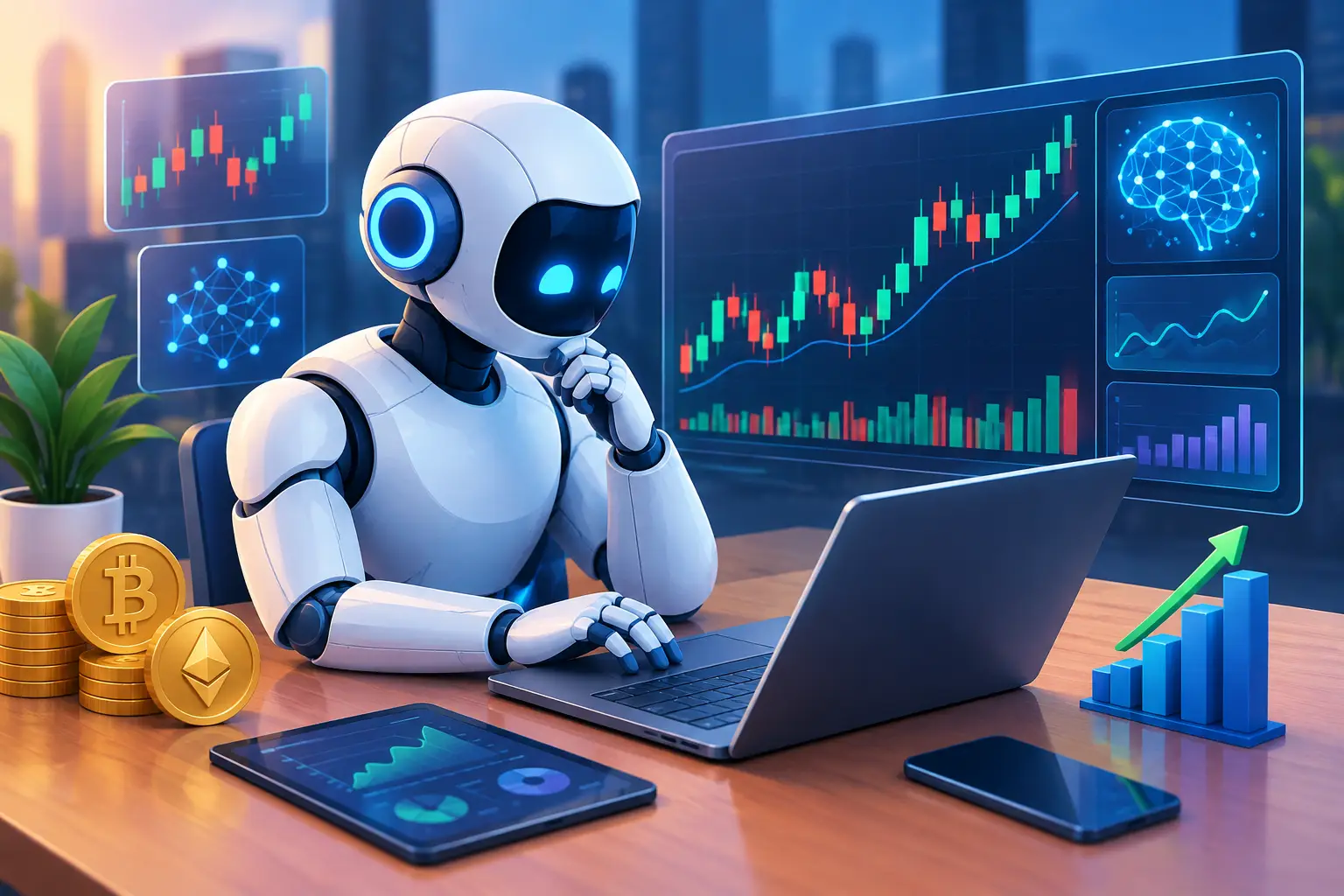
Within minutes of the market opening, a trader might simultaneously see an inflation figure, a company earnings report, a sharp Bitcoin move, and dozens of social media posts. Processing this volume of information by hand is impossible. This is exactly where artificial intelligence in trading comes in - not as an "accurate forecasting machine," but as a tool that quickly organizes data, looks for patterns, and helps you prepare your decisions.
This distinction is crucial. AI can be effective in the speed of analysis, but it cannot take responsibility for your capital. It doesn't know your financial goals, time horizon, psychological resilience, or how much loss you can tolerate on a specific position. That's why its use should serve a professional process rather than replace it.
What AI in trading actually does
AI is often associated with one question: "Will it tell me what to buy?" In practice, its most useful functions are less spectacular. It processes large volumes of price, fundamental, and text data, identifies recurring signals, groups assets, and helps you focus on the factors relevant to your trading plan.
For example, a model can check thousands of historical candles to see how a specific stock behaved after an earnings report was published. Another system evaluates the tone of news headlines and determines whether informational pressure on a sector was positive or negative. Yet another algorithm tracks correlations - for instance, between the dollar index, gold, and technology stocks.
This analysis doesn't automatically give you an answer. It gives you context. And context becomes valuable when you compare it against your strategy's rules: where is the entry level, where does the idea get invalidated, what is the position size, and under what conditions do you not open a trade at all.
Three areas where AI is most practical
Data filtering and market monitoring
A trader's time is often lost not in analysis, but in searching for information. AI can filter the market using predefined criteria: finding high-volume stocks, identifying unusual volatility, comparing relative sector strength, or flagging important events on the economic calendar.
In this case, you're not trusting its "opinion." You're using it as a fast analyst that leaves on your desk only the setups worth checking. The final assessment should still be based on the chart, fundamental context, and risk parameters.
Testing trading ideas
If you have a rule, for example: "I only buy when the price moves back above the 200-day moving average and volume increases," AI and coding assistant tools make it easier to backtest this rule historically. You can see how many trades the strategy would have generated, what the maximum drawdown was, in which period it worked, and where its logic broke down.
But the most common trap here is an overly beautiful backtest. If a strategy is "fitted" to old charts with dozens of parameters, it might describe the past perfectly and fail to work at all in the future. This is called overfitting - the model learns historical noise rather than a real market edge.
Trading journal analysis
Both beginner and experienced traders often repeat the same mistake because they don't look at their own data. AI can extract a practical picture from your journal: during which hours you enter trades most impulsively, on which instrument you break your stop-loss, how often you add to a losing position, or what happens to your results after two consecutive wins.
This use is especially valuable because it shifts the focus from forecasting to process. The market isn't fully controllable, but the quality of your entries, position size, and adherence to rules are.
Why an AI signal is not a trading plan
On social media, you'll often see promises: a bot finds "guaranteed" entries, an algorithm makes money every day, or a chatbot names the next strong coin with precision. This kind of language is already a warning sign. No model has constant access to the future, and the market changes even when historical data paints a perfect picture.
Particular caution is needed in the crypto market, where liquidity, breaking news, and the activity of large players can significantly move prices in a short time. In Forex, a macroeconomic announcement or a single phrase of central bank rhetoric can immediately override a technical signal. In stocks, company results, management guidance, and sector dynamics add further influence.
AI often cannot distinguish between cause and correlation. It might record that two factors moved together in the past, but it cannot determine whether this relationship will continue in a new regime. For example, a model that was successful during a period of low interest rates may become less effective when monetary policy tightens.
How to verify an idea generated by AI
Treat AI's response as a hypothesis, not a command. First, check the source and date. Is the conclusion based on yesterday's news, an old quarterly report, or outright inaccurate data? Then open the chart and determine where your idea's invalidation point is.
After that, a harder question must be asked: what happens if I'm wrong? If the answer is "I don't know," the position isn't ready yet. You should have a stop-loss set in advance, a defined risk per trade, and a plan for the case where the market moves against you.
A practical workflow might look like this: AI filters assets; you assess the trend, levels, and volume; you check the calendar for upcoming events; you determine the risk; then you record the reason for the trade in your journal. In this sequence, technology speeds up the work, but it doesn't replace discipline.
Automated trading: speed is both valuable and dangerous
When an algorithm not only performs analysis but also opens trades automatically, technical risk increases. An incorrect parameter, a data delay, a broker API glitch, or unexpected volatility can quickly turn into a major loss. That's why automation shouldn't start with full real-capital involvement.
It's better to first test the system in a demo environment or with a small size. Pay attention not only to profit but to execution quality: how closely the order fills to the planned price, what happens during high spreads, what the daily loss limit is, and whether the system stops under non-standard conditions.
An automated strategy especially needs clear constraints: maximum position size, daily loss limit, the number of simultaneously open trades, and the ability to manually shut it down. If you can't establish these rules, then it's not automation you need first - it's the foundation of your strategy that needs more work.
What skills remain essential
The rise of artificial intelligence doesn't diminish the importance of foundational market knowledge. On the contrary, someone who doesn't understand technical analysis, fundamental factors, and risk management won't be able to notice when a model gives a wrong answer.
It's important to understand trend, support and resistance, volatility, position sizing, risk-reward ratio, correlation, and the impact of the economic calendar. Probabilistic thinking is also necessary: a good trade doesn't mean a guaranteed profit - it means a correctly executed process whose edge becomes apparent over many trades.
In Traders' Hub's educational approach as well, technology should serve exactly this logic: reading the real market, structured analysis, and justifying your own decisions. A tool can be fast, but a trader's development begins when they can explain why they opened a position and under what conditions they will close it.
Use AI to spend less time on noise and more on quality decisions. Before every new signal, check one simple thing: does this idea serve your rules, or does it just make you want to act? Often, the answer to exactly this question is what protects your capital.