


How to Choose the Risk-Reward Ratio
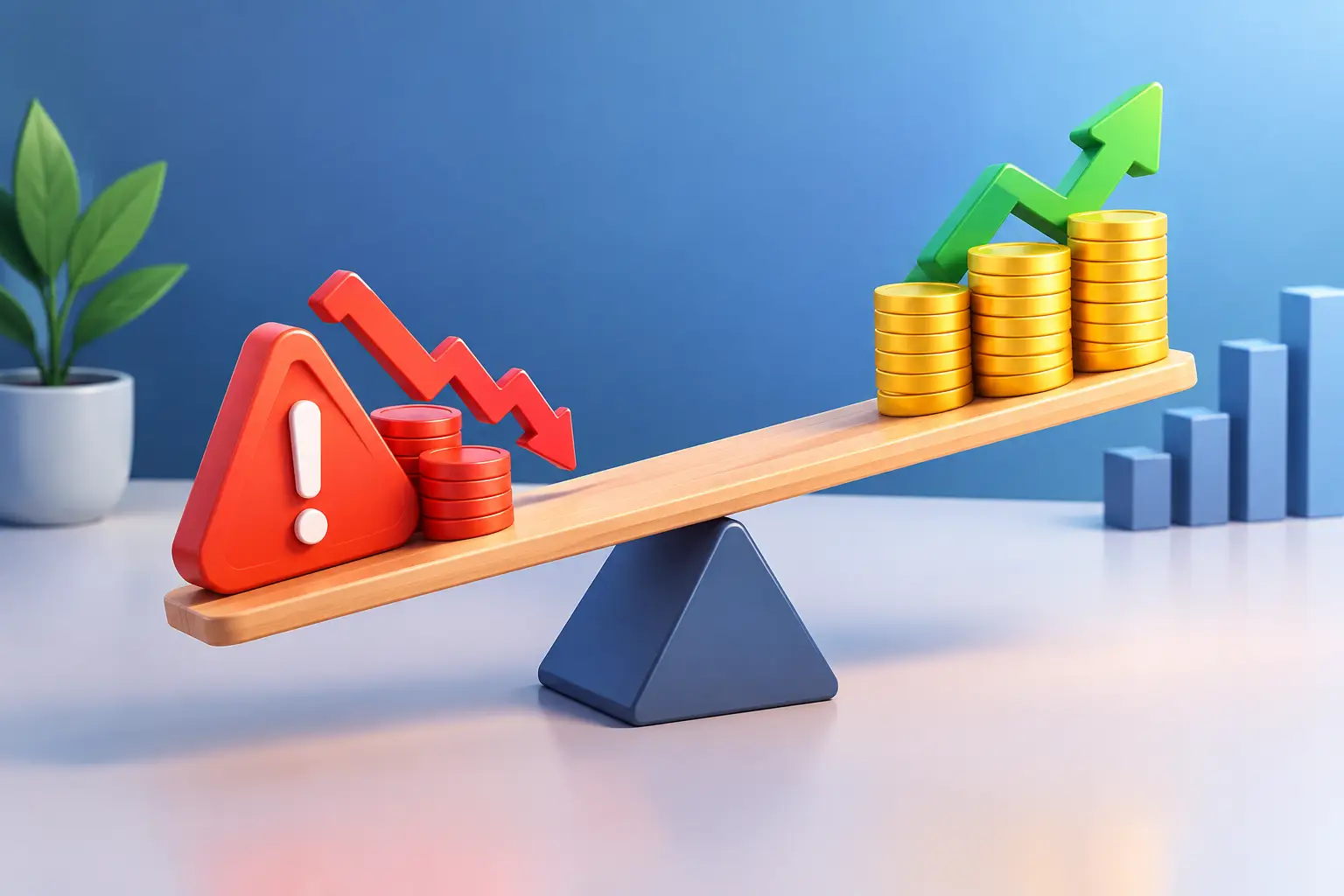
In trading, the most expensive mistake isn't always a wrong forecast. Often the problem is that even with a correct idea, a trader risks more than the acceptable profit can justify. That's exactly why the question — how to choose a risk-reward ratio — should arise before opening a position, not after the price has already started moving against you.
The risk-reward ratio helps you turn a signal that looks attractive at first glance into an actual trading decision. It doesn't guarantee profit, but it shows whether a specific trade has enough mathematical edge to be worth taking. For a disciplined trader, this is part of the plan, just like analysis, position sizing, and the stop-loss.
What the risk-reward ratio shows you
Risk is the amount of money or price distance you will lose if the idea doesn't work out and the stop-loss is triggered. Reward is the expected profit if the price reaches your target level. These two numbers form the ratio.
If the entry price is $100, the stop-loss is at $95, and the profit target is at $110, you're risking $5 per share and expecting to gain $10. In this case, the risk-reward ratio is 1:2 — meaning for every 1 unit of risk, there are 2 units of potential profit.
It's important to read the direction correctly. A 1:3 ratio often looks better than 1:1, because the potential reward is three times the risk. However, chasing only a high number is a mistake. A 1:5 ratio will be useless if the target is completely unrealistic and the price rarely reaches it.
Ratio and win rate don't mean the same thing
Many beginner traders believe that for success, the majority of trades need to be profitable. In reality, the result is determined jointly by the win rate and the average risk-reward ratio.
For example, a system with a 1:2 ratio theoretically needs roughly more than a 34% win rate to be in profit before accounting for commissions and slippage. If a system works at 1:1, the number of losing and winning trades should be roughly equal. This doesn't mean every trade will be identical, but it helps you think in statistics instead of emotions.
How to choose the risk-reward ratio for a specific trade
You should never start the ratio with a wish to have "at least 1:3." The correct process begins with market structure: where your trading idea loses its logic, where the price is realistically expected to go, and how much room there is between these two points.
1. Determine where the idea is invalidated
The stop-loss shouldn't be placed randomly, just because you don't want to lose a certain percentage of the account. First, find the level beyond which your analysis no longer holds. In a long position, this could be below the last significant low, below a consolidation boundary, or beyond a broken support level. In a short position — above the corresponding high.
Then assess whether this level is sufficiently distanced from normal price noise. A stop that's too tight often closes the trade prematurely, while an excessively wide stop reduces position size and sometimes signals a problem with the quality of the idea itself.
2. Choose the target level based on the market
The profit target shouldn't simply be a desired amount. Look at the nearest resistance or support, previous highs and lows, liquidity zones, the boundary of a price range, or the level where other participants might start taking profit.
If the distance from entry to the stop is 2%, while only a 2.5% space remains to the nearest realistic resistance, the ratio comes out to roughly 1:1.25. The signal may be technically good, but such a trade may not be profitable enough for your system. The alternative is to wait for a better entry, skip the position, or create a plan for partial profit-taking.
3. Calculate the number, not the impression
The formula is simple:
Risk-reward ratio = potential profit / potential loss.
If the entry is at 50, the stop is at 48, and the target is at 56, the risk is 2 units and the reward is 6 units. The result is 1:3. Make this calculation accounting for commission, spread, and expected slippage as well, especially in short-term Forex and crypto trades. A small cost can significantly reduce a good ratio on paper in the actual outcome.
1:2 isn't always the best choice
1:2 is often considered a sensible starting framework, as it gives you a certain margin for error. But this isn't a universal rule. A scalper may have a profitable strategy with a high win rate and a 1:1 or 1:1.5 ratio. A swing trader, on the other hand, may take positions with fewer but larger moves, where 1:3 or 1:4 is realistic.
What matters is that your ratio matches the actual data of your strategy. If a breakout strategy often gives a quick but short move, setting an artificially distant target will worsen the statistics. If you close a position too early in a trending market at just a 1:1 profit, you may miss out on part of the strongest moves.
So test at least a few dozen historical or demo trades. Write down where you entered, where the logical stop was, what level the price reached, and what result you would get with your rules. A single success doesn't confirm a system, and a single loss doesn't invalidate it.
Position size protects the account, the ratio protects the quality of the decision
The risk-reward ratio cannot replace position size management. Two traders might see the same 1:3 trade, but one risks 1% of the account while the other risks 15%. The first will survive a losing streak and continue gathering data. For the second, a few ordinary losses could seriously damage the account.
First, decide how much money or what percentage of the account you can afford to lose on a single trade. Then, based on the distance to the stop-loss, calculate the position size. If the stop is wide, the position should be reduced. Moving the stop just so you can buy more lots or more coins is not risk management.
In practice, it's useful to have a predefined maximum risk per trade and a daily limit as well. This is especially important in highly volatile crypto assets, where a rapid move can expand the planned loss. In stocks, account for overnight gaps, while in Forex, be mindful of the timing of major macroeconomic releases.
Use a trading journal to tailor the rules to your own data
A good ratio isn't judged only at the moment of opening. After a trade is closed, record the reason, entry price, stop, target, actual outcome, and whether you followed the plan. Within a few weeks, you'll already see which market, timeframe, and setup give you the best ratio.
Also highlight cases where the price first moved in your favor but didn't reach the target. This may indicate that partial profit-taking, moving the stop to breakeven, or a closer first target would suit your system better. Only make changes after sufficient data, not under the influence of one emotional day.
In Traders' Hub's educational approach as well, risk management isn't a separate topic but a unified process of analysis, position sizing, and trading journal. Reading the market becomes a practical skill when every idea comes with a predefined risk and a verifiable plan.
Before opening your next trade, ask yourself one simple question: if this idea doesn't work out, exactly where do I admit the mistake, and if it does work out, where is my realistic target? The distance between these two answers will often tell you more about the quality of the trade than the most convincing indicator.