


How to Manage Trading Risk in Practice
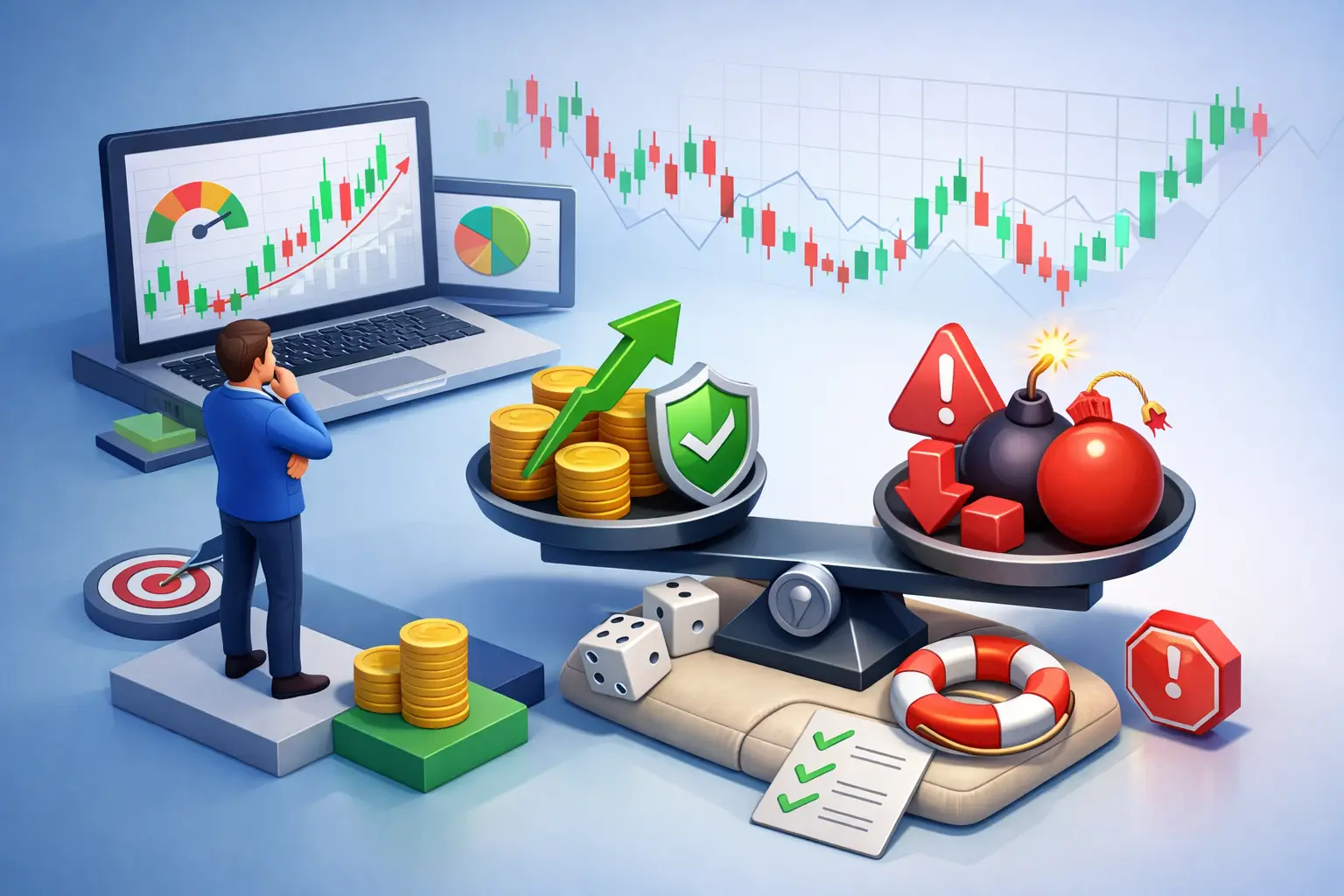
A single successful trade can mean a lot emotionally, but a trader's outcome is determined by dozens and hundreds of decisions. That's exactly why the question - how to manage trading risk - isn't just about setting a stop-loss. It's a system that protects you from one bad idea, an emotional decision, or an unexpected market move.
The market doesn't give you control over price. You can analyze charts, economic data, and news, but you can't force an asset to move in your direction. What you do control is how much you risk, where you admit a scenario didn't work out, and what action you take after a loss.
How to manage trading risk before opening a position
Risk management doesn't start when a position is already in the red - it starts when you still only have a trading idea. Before placing an order, you should have a clear answer to three questions: what is the reason for entering, at what price does this idea get invalidated, and how much will you lose if the price reaches that point.
If any of these three answers is vague, opening the position is more of an impulsive decision than the execution of a plan. For example, the phrase "it'll probably go up" isn't a trading argument. A concrete argument might be: price is holding a significant support zone, volume is increasing, and the stop-loss is placed below the level whose breach would invalidate the idea.
It's especially useful for beginners to write down the risk amount separately before each trade. When you know you're risking at most 50 GEL or 1% of capital on this idea, the decision becomes far less emotional. The goal isn't to close every transaction with a profit. The goal is for no single transaction to cause damage to the account that would be difficult to recover from.
Position size: the key number in risk
Many traders first choose the quantity of the asset and only then think about the stop-loss. The correct order is the opposite: first determine where the idea's invalidation point is, then calculate the position size.
The principle is simple: position size should match your predetermined risk. Say you have 10,000 GEL in your account and you allow a maximum loss of 1%, or 100 GEL, per trade. If the difference between the entry price and the stop-loss is 5 GEL per share, you can buy 20 units. In this case, if the stop-loss is triggered, the estimated loss will be 100 GEL, before accounting for commissions and possible slippage.
This approach works across all markets, though the calculation details differ. For stocks, the unit price and quantity matter; for crypto - high volatility and liquidity; for Forex - pip value, lot size, and leverage. Different instruments don't change the main rule: risk first, then volume.
1% isn't a universal number. A short-term trader who opens many positions per week might find 0.25%-0.5% more suitable. A less active investor might use 1%-2%. This depends on your strategy, capital, experience, and how many simultaneous positions you have open.
The stop-loss shouldn't be an arbitrary number
The stop-loss isn't an "unpleasant" order that you should only widen so you don't have to realize a loss. It predetermines the price at which you admit: the market didn't confirm my scenario.
In technical analysis, the stop-loss is often placed beyond support, resistance, or the most recent local low or high. But a stop placed too close can be triggered by normal volatility, while one placed too far away will reduce the position size so much that the trade becomes impractical. This requires a balance between the asset's volatility and the logic of your trading idea.
A stop-loss doesn't provide a full guarantee. During major news events, low liquidity, or market opening, price may skip over your level and execute at a worse price. That's why actual risk is sometimes higher than planned. In such conditions, reducing the position or skipping the trade is often a better choice than being tempted purely by high potential profit.
Risk and expected reward in one system
A good risk/reward ratio means that the expected profit exceeds the amount you're risking. For example, if you risk 100 GEL down to the stop-loss and the potential profit up to the target price is 200 GEL, the ratio is 1:2.
However, 1:2 by itself isn't a guarantee of a good trade. You need to ask yourself how realistic the chance actually is of price reaching the target level. A take-profit set too far away creates nice-looking math but may rarely get hit. On the other hand, a strategy with a 1:1 ratio can also be profitable if its win rate is high and costs are controlled.
The outcome is determined by expectancy math: win frequency, average win, average loss, and commissions. That's exactly why one successful week can't prove a strategy's quality. You need data from a sufficient number of trades.
Leverage increases responsibility, not just opportunity
Leverage lets you control a large position with small capital, but it equally accelerates both profits and losses. With 10x leverage, a 1% move in the asset creates roughly a 10% effect on your used margin, before costs. High leverage is especially dangerous when position size is chosen without a stop-loss.
In the fast-moving crypto and Forex markets, traders often want to avoid "missing an opportunity." But missing a chance doesn't destroy an account, while an unplanned large loss can. If, under leverage conditions, you can't precisely calculate the liquidation price, margin requirement, and maximum loss, the position is still too complex for you.
Several positions isn't always diversification
Opening five different positions doesn't mean you've split your risk five ways. If, for example, tech stocks all react simultaneously to rising interest rates, or several crypto assets follow Bitcoin's movement, your positions are strongly correlated. One macroeconomic event will affect all of them at once.
That's why you should evaluate your total open risk, not just each position separately. If you risk 1% of capital on each of three positions, but all three depend on the same market factor, you effectively have a combined 3% risk. In such cases, either reduce the number of positions or the size of each one.
Trading day rules set boundaries for emotion
The most common mistake after a loss is trying to immediately recover the lost money. This state is often called "revenge trading": the trader starts taking larger positions, becomes less selective about setups, and breaks their own rules.
To counter this, set a daily and weekly loss limit in advance. For example, if you hit three planned losses in a day or lose 2% of the account, stop trading and review the trades you made. This isn't weakness. It's a decision to not let a bad session turn into a bad week.
A brief but clear pre-trade checklist is also useful:
- I know the entry, stop-loss, and target price levels;
- position size is calculated based on monetary risk;
- I've checked for any significant economic event or company report;
- correlation with open positions has been assessed;
- I'm opening the trade based on a plan, not out of boredom, fear, or excitement.
A trading journal shows you your real risk
Memory is an unreliable analyst. We remember winning trades more clearly, while rule violations are often forgotten. A trading journal replaces this bias with data.
Record the asset, entry and exit price, position size, planned risk, outcome, trade rationale, and emotional state. After a few dozen entries, you'll see where you lose most often: during news events, with overly wide stops, late entries, or rule violations. In Traders' Hub's educational approach as well, practice and analysis of executed decisions turns theory into a skill you can actually apply in the real market.
Risk management doesn't eliminate losses. It gives you the ability to make losses measurable, limited, and part of the learning process. Before every new position, return to one question: if this idea doesn't work out, can I calmly accept this loss? If the answer is no, the best trading decision might simply be not opening the position.