


The Impact of Interest Rates on Markets
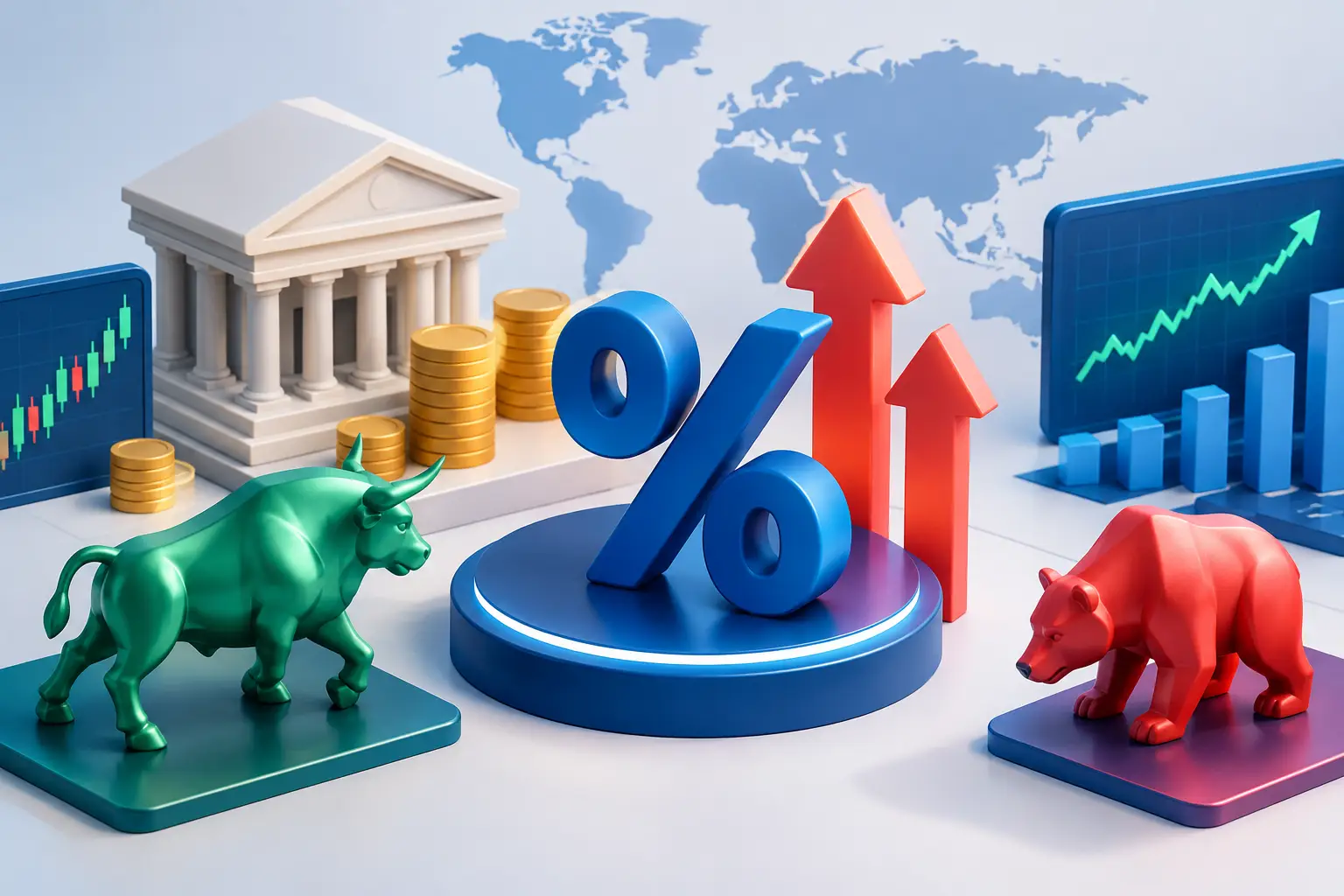
In the minutes before a central bank's decision is announced, the market is often more nervous than it is after the decision itself. If the rate stayed unchanged but the bank's statement showed a stricter tone on inflation, stocks may fall, the currency may strengthen, and bond yields may rise. This is precisely why the impact of interest rates on markets is not just a change in a single number - it is a process of repricing expectations, liquidity, and risk.
For a trader, the main question is not only: did the rate go up or down? A more important question is: what did the market expect, what did the central bank say about future steps, and how much does this message differ from what was already priced in? A strong move is born in this gap.
Why interest rates change asset prices
The interest rate is the price of money. When it rises, borrowing becomes more expensive, deposits and short-term government instruments become relatively more attractive, and business and consumer spending may slow down. When the rate falls, credit becomes cheaper, more money circulates in the economy, and investors often start seeking higher returns.
This mechanism doesn't work the same way in every country or for every asset. For example, a rate increase can be positive for some banks, since their interest margin widens. At the same time, the same environment is negative for highly indebted companies: their financing costs rise and profit forecasts weaken.
An asset's price is also the present value of its future cash flows. The higher the discount rate, the less expected future profit is worth today. That's why high-growth technology companies are often particularly sensitive to monetary policy. In their case, the investor is largely buying future profit, not just the current result.
Impact on stocks: the index doesn't always react the same way
The initial interpretation of a rate hike is often negative for stocks, though this isn't an automatic rule. If the central bank raises rates because the economy is strong and employment is growing, the market may take this as a sign of economic resilience. If the increase is unexpectedly sharp and the cause is high, uncontrolled inflation, the reaction is often more painful.
Sector differences also matter. Growth companies, real estate funds, and highly indebted businesses are usually more vulnerable. Energy, defense, or consumer staples sectors sometimes look relatively protected, though their behavior also depends on the pace of economic growth.
A trader shouldn't conclude that a rate hike means selling any stock. First, assess whether the decision was expected, whether the forecast for future rates has changed, and what's happening with the company's earnings. Monetary policy creates the backdrop, but a specific stock's movement is often determined by corporate results, sector news, or valuation levels.
Why expectations matter
The market prices in the future in advance. If participants expect a 0.25 percentage point increase and the central bank does exactly that, the main move may start at the press conference. A single phrase about slowing inflation, labor market weakness, or the need for further tightening can turn out to matter more than the decision itself.
That's why you should pay attention not only to the current rate, but also to expectations for future meetings. The bond market often registers this shift earlier than stock indices.
Bonds: price and yield move in opposite directions
The bond market is the most direct mirror of interest rates. When new bonds offer a higher coupon, older, lower-coupon bonds fall in price. As a result, their yield rises. When rates fall, the reverse process occurs.
Maturity matters especially here. Short-term bonds react more closely to the central bank's nearest steps, while long-term bonds reflect a broader outlook on inflation, economic growth, and fiscal risks. If short-term yields are higher than long-term ones, the market is often signaling a possible economic slowdown or future rate cuts.
An investor who already holds bonds in their portfolio should understand duration risk. The longer an instrument's maturity, the more painfully a rise in market rates can affect its price. This doesn't mean long-term bonds are always a bad choice - if you expect rate cuts in the future, they may have greater potential for price appreciation. But this position requires a clear scenario and a risk limit.
The currency market: rates attract capital, but not always
A high rate is often a supportive factor for a currency. If a country's yields are rising and investors view the economy as stable, foreign capital inflows may strengthen. This increases demand for the local currency.
However, a high rate alone isn't enough. A currency is also affected by inflation, foreign trade, political risk, economic growth, and other countries' policies. For example, if one central bank raises rates but another country is pursuing an even stricter monetary policy, the reaction in the currency pair could be the opposite.
In forex, it's especially risky to open a position within seconds of a decision based solely on the headline. Spreads widen, prices change rapidly, and the initial move may soon reverse direction. A more disciplined approach is to mark important levels in advance, determine position size, and wait to see how the market receives the full statement.
Crypto assets and the liquidity cycle
Crypto assets are often perceived as high-risk assets, so interest in them may strengthen in an environment of cheap money and growing liquidity. When real yields rise and safe instruments become more attractive, part of speculative capital often moves away from risky markets.
But the crypto market isn't governed by rates alone. Regulation, network technology upgrades, exchange flows, positioning by major players, and news about specific projects sometimes become a stronger factor than a monetary signal. That's why a rate decision in crypto should be viewed as macro backdrop, not a ready-made trading signal.
How a trader should prepare for a central bank meeting
On interest rate decision days, the main advantage isn't a quick guess but a plan made in advance. First, mark the decision time, press conference, and important data for that week - inflation, employment, retail sales, and GDP - in your economic calendar. A single meeting's outcome often needs to be read in the context of this data.
Then formulate two or three scenarios. What happens if the decision matches expectations? What might happen in case of an unexpected hike or cut? Which asset are you watching, and at what price level would your idea be invalidated? This kind of preparation reduces emotional reaction.
Don't increase your position size just because high volatility is visible. A strong move is both an opportunity and increased risk. Especially in leveraged trading, a small, predetermined risk is more valuable than trying to catch a single piece of breaking news.
The impact of interest rates on markets: a practical framework
After every decision, you can work through four questions. First: what was the market's expectation? Second: what changed in the statement and forecasts? Third: which asset's price already reflected this news? Fourth: where is your risk point if the market doesn't confirm your scenario?
Using this framework is useful in stocks as well as forex and crypto. Traders' Hub's educational approach is based on exactly this logic: an economic event should be translated into a specific market context, chart levels, position size, and a decision to be evaluated in a trading journal.
During monetary policy announcements, don't try to catch every move. Choose one market, observe its reaction over several meetings, and record what the market expected and what actually happened. Such records are, over time, a far more reliable compass than noisy headlines or quick predictions on social media.