


Setting a Stop Loss for Disciplined Trading
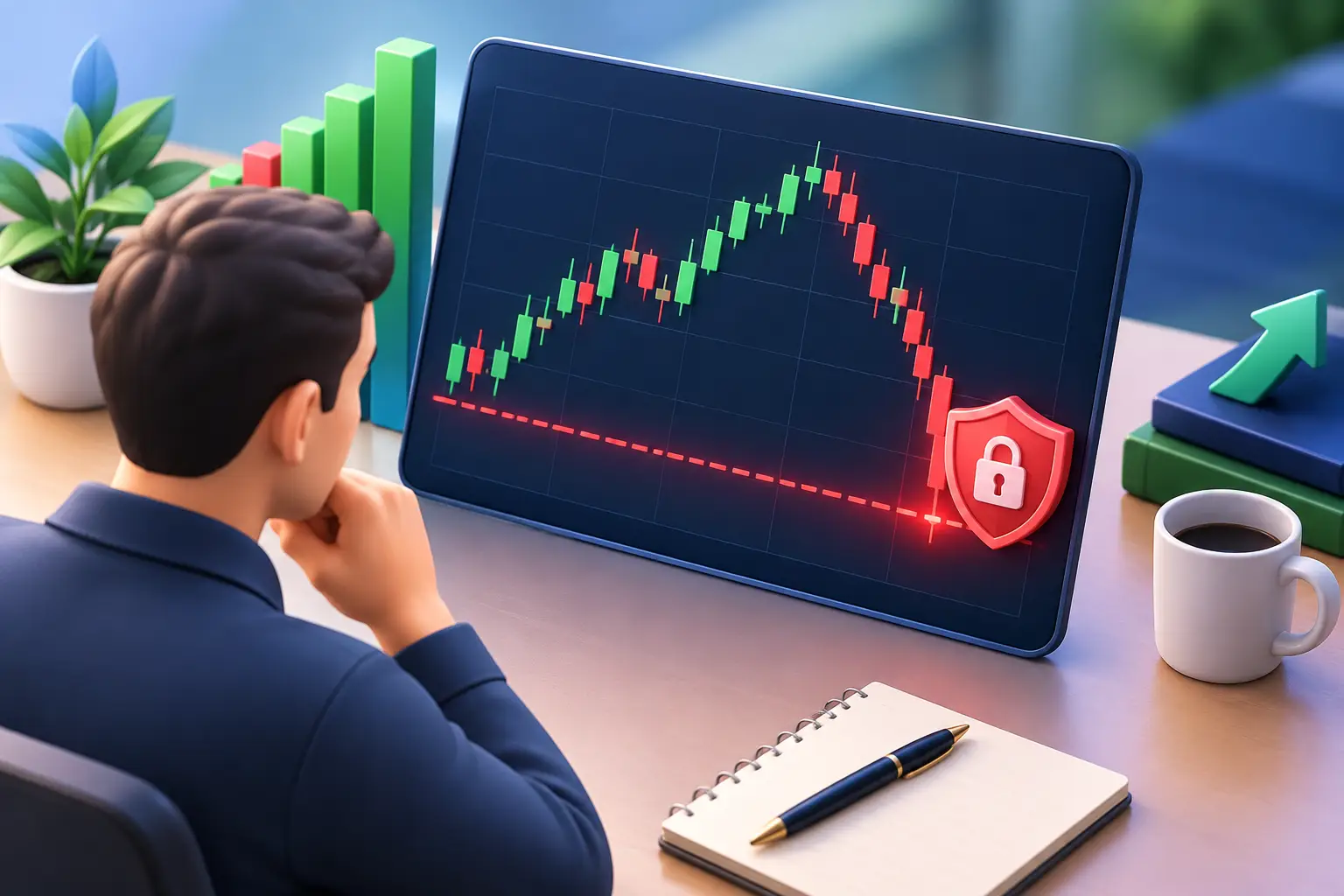
A single bad position shouldn't determine the future of your trading account. That's exactly why setting a stop loss isn't just about clicking a button on the platform - it's a decision made in advance about where you'll acknowledge that your trade idea no longer works and protect your capital.
Many beginners only consider a stop loss after a position has already moved significantly against them. At that point, analysis no longer drives the decision - it's replaced by hope, fear, and the desire for a quick fix. In disciplined trading, risk should be known before the position is opened: where you enter, where you exit if you're wrong, and how much you lose in that scenario.
What a stop loss actually does
A stop loss is a predetermined price at which a broker or exchange receives an instruction to close the position. On a long position, it's typically placed below the entry price; on a short position, above it. Its main function is to limit the loss on a single trade, not to guarantee that every trade will be successful.
A good stop loss doesn't just protect your money. It protects your trading plan too. If a particular support level was supposed to hold, but price breaks it clearly and with volume, the original thesis may be invalidated. Exiting the position in that case is a professional response, not a failure.
That said, a stop isn't a guarantee. During high volatility, low liquidity, or major macroeconomic news, price can jump past your specified level. As a result, the execution price ends up worse than expected. This is called slippage, and it's especially important to account for in crypto assets, small-cap stocks, and the minutes around news releases.
Setting a stop loss starts with the trade idea
Stop distance shouldn't be determined solely by the phrase "I can't afford to lose more than 5%." Sometimes 5% is too wide for a given instrument, and sometimes it can even be within normal daily movement. The right question is: at what price does my analysis become wrong?
Say a stock showed a bullish reaction from a significant support zone and you open a long position. If price closes below support and breaks the structure, the original thesis weakens. In that case, the stop should logically sit below support, with a small technical buffer - not placed arbitrarily at a round number.
In forex, this might be the previous swing low or a significant daily low. In crypto, it could be the lower boundary of a consolidation range, or a level whose loss shifts volume to the sell side. An investment-style position has a different time horizon: daily chart noise may be less important than the fundamental reason you bought the asset in the first place.
Technical levels and market noise
Placing a stop right at an obvious support level carries its own risk. Many participants have orders at the same level, so price can briefly spike into that zone, trigger stops, and then return to its original direction. This so-called liquidity grab can't be fully avoided, but you can account for it using average volatility, candle range, and the specifics of the instrument.
This doesn't mean you should widen your stop indefinitely. An excessively wide stop is only acceptable if you reduce your position size accordingly. Otherwise, the risk on a single trade will exceed your own rules.
Define risk first, then position size
One of the most common beginner mistakes is buying a desired number of shares, lots, or coins first and only then adjusting the stop. The process should work the other way around: first, your analysis determines the invalidation level, then you calculate what size position you can open.
The simple formula is:
Position size = amount you're willing to risk per trade / difference between entry price and stop price
If your account is $10,000 and you're risking 1% per position, or $100, a $2 distance to the stop allows you to buy a maximum of 50 units. If the technically correct stop is $4 away, you need to reduce the position to 25 units.
The percentage isn't the same for everyone. An active trader might work well with 0.5%-1%, while a long-term investor may use a different framework. What matters is that the rule is set in advance, repeatable, and suited to the size of your account. Leverage doesn't eliminate this principle - it only increases the speed at which profit and loss change.
Which type of stop should you use
There are several types of stop orders available in the market, and the differences between them produce real practical consequences. A standard stop-market order converts into a market order once the stop price is reached. Its advantage is a high probability of execution, though in fast-moving markets the final price can differ from your stop level.
A stop-limit order lets you define the worst price at which you're willing to accept execution. In exchange, there's a risk that during a sharp decline the order won't execute at all, leaving your position open. This is a particularly important choice for illiquid assets and overnight sessions.
A trailing stop follows price in the favorable direction and helps protect a portion of accumulated profit. But if you place it too close, normal fluctuation can knock you out of the position early. A trailing stop is useful in trending markets, while in sideways movement it often becomes overly sensitive.
Don't move your stop to increase your loss
The most costly habit is moving the stop when price approaches it. The trader tells themselves "the market just needs a little more room," but often the real reason is an unwillingness to accept the loss. If new information genuinely changes the analysis, that should be a reasoned decision - not an emotional reaction to a position in the red.
Moving a stop in the direction of profit is a different matter. If the position has moved according to plan and market structure has formed a new swing low or swing high, reducing risk makes sense. However, moving to breakeven too early can also knock you out of a good trade. The decision depends on your strategy, timeframe, and the volatility of the instrument.
News, overnight risk, and special situations
Economic calendar events - inflation, interest rates, employment data, corporate earnings - often disrupt the usual behavior of price. At such times, even a perfectly placed stop on the chart can be executed with slippage. If your strategy isn't news trading, the most rational decision is sometimes to reduce your position or wait until the event has passed.
Also keep in mind that overnight gaps in the stock market are real. Price can change after the close and open the next day well below your stop. The crypto market operates 24/7, but that doesn't eliminate the risk of rapid liquidation, especially on leveraged positions.
Review your rules in a trading journal
You can't judge the quality of a stop loss from a single trade. Record the reason for entry, the logic behind the stop, the planned risk, the actual execution price, and the outcome. After several dozen trades, patterns will emerge - whether you often place stops too close, enter during high volatility, or break your own rules.
Such records separate analysis from emotion. In Traders' Hub's educational approach, this connection is exactly what matters: reading the chart, calculating position size, and evaluating the outcome in a journal together form a single trading process.
A stop loss isn't a wall built against the market. It's a personal system of order that gives you the right to close a wrong idea at a small cost and preserve your capital for the next, better-reasoned opportunity.