
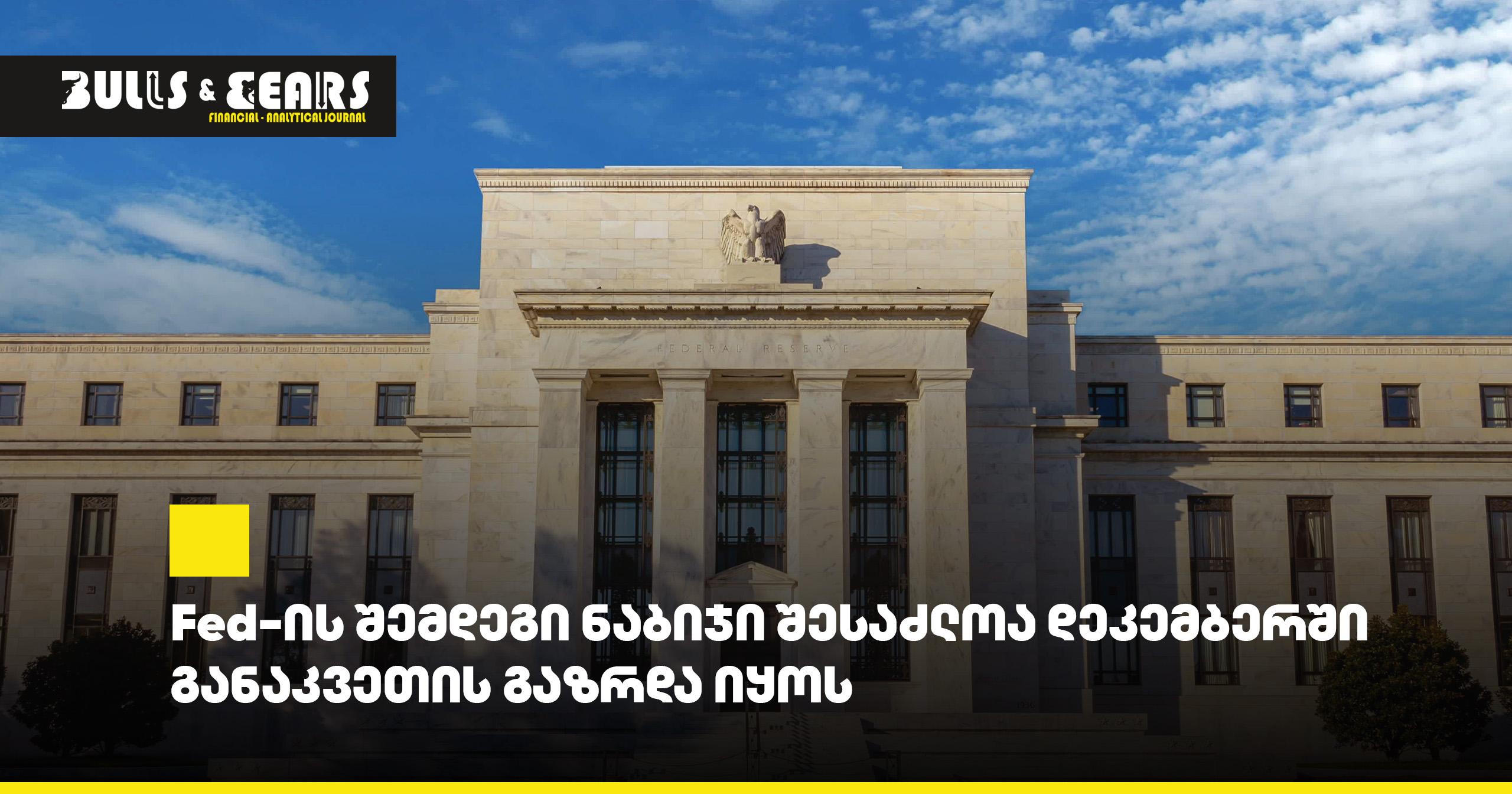
The Fed's next move could be a rate hike in December
According to Deutsche Bank's assessment, statements from Federal Reserve officials last week reflected a position leaning toward tighter monetary policy. In economists' view, discussion within the Fed increasingly concerns the pace and scale at which interest rates should rise, rather than whether additional tightening is needed at all.
Economists led by Amy Yaeng noted that this trend was also evident in the minutes from the Fed's October meeting. According to the document, nearly all participating members expected further rate increases ahead. For several of them, leaving the rate unchanged in October was a difficult decision, while two officials noted that a hike larger than 0.25 percentage points could be considered in December if inflation data proves unfavorable.
Among the advocates of a relatively moderate tightening of monetary policy is New York Fed President John Williams. According to him, the current situation does not require "drastic action," though all options — including raising rates at several consecutive meetings — remain on the table.
Philadelphia Fed President Anna Paulson and San Francisco Fed President Mary Daly also favor a gradual and cautious approach. According to Deutsche Bank economists, Williams' and Paulson's willingness to consider several consecutive hikes suggests that gradual tightening in 0.25-percentage-point increments is gaining broader support.
Cleveland Fed President Beth Hammack, for her part, supports small, consistent increases and sees no need for a larger step at this stage.
Positions diverge among Fed members
Among the advocates of tighter policy, Deutsche Bank economists point to Fed Board of Governors members Lisa Cook and Christopher Waller, as well as St. Louis Fed President Alberto Musalem.
By their assessment, Waller leans toward a 0.50-percentage-point rate hike in December unless there is a clear signal at the January meeting of an additional step being taken. In his view, fully reversing the three so-called preventive cuts made in 2025 is the minimum necessary step.
Musalem believes tightening should begin soon and expects several hikes before spring. His goal is to raise the real monetary rate to 2%-2.5%, whereas the current level is at the lower bound of the 1%-1.5% range.
Fed Board of Governors member Michael Barr also favors additional hikes, while Chicago Fed President Austan Goolsbee believes the pace of tightening should depend on inflation data received going forward.
Deutsche Bank's forecast: three consecutive hikes
Under Deutsche Bank's baseline scenario, the Fed will raise interest rates by 0.25 percentage points at each of the next three meetings — in December, January, and March. As a result, the target range for the federal funds rate would rise to 4.5%-4.75%.
The bank's economists do not expect a single 0.50-percentage-point hike, as they believe a 0.25-point step reflects broader consensus among Fed officials. They further note that even several officials favoring tighter policy support small but frequent changes, while support for a larger hike would likely emerge only in the event of unfavorable inflation data.
According to the economists, tightened conditions and increased volatility in financial markets recently are pushing the Fed toward more cautious action. Nevertheless, a cumulative increase of 1 percentage point by the end of the first quarter of 2027 would fully reverse the 2025 preventive cuts and bring monetary policy close to the level the bank considers neutral.
Get our latest market analysis and financial insights delivered straight to you. No spam — just the signal.