

Demo Account or Live Trading for Beginners
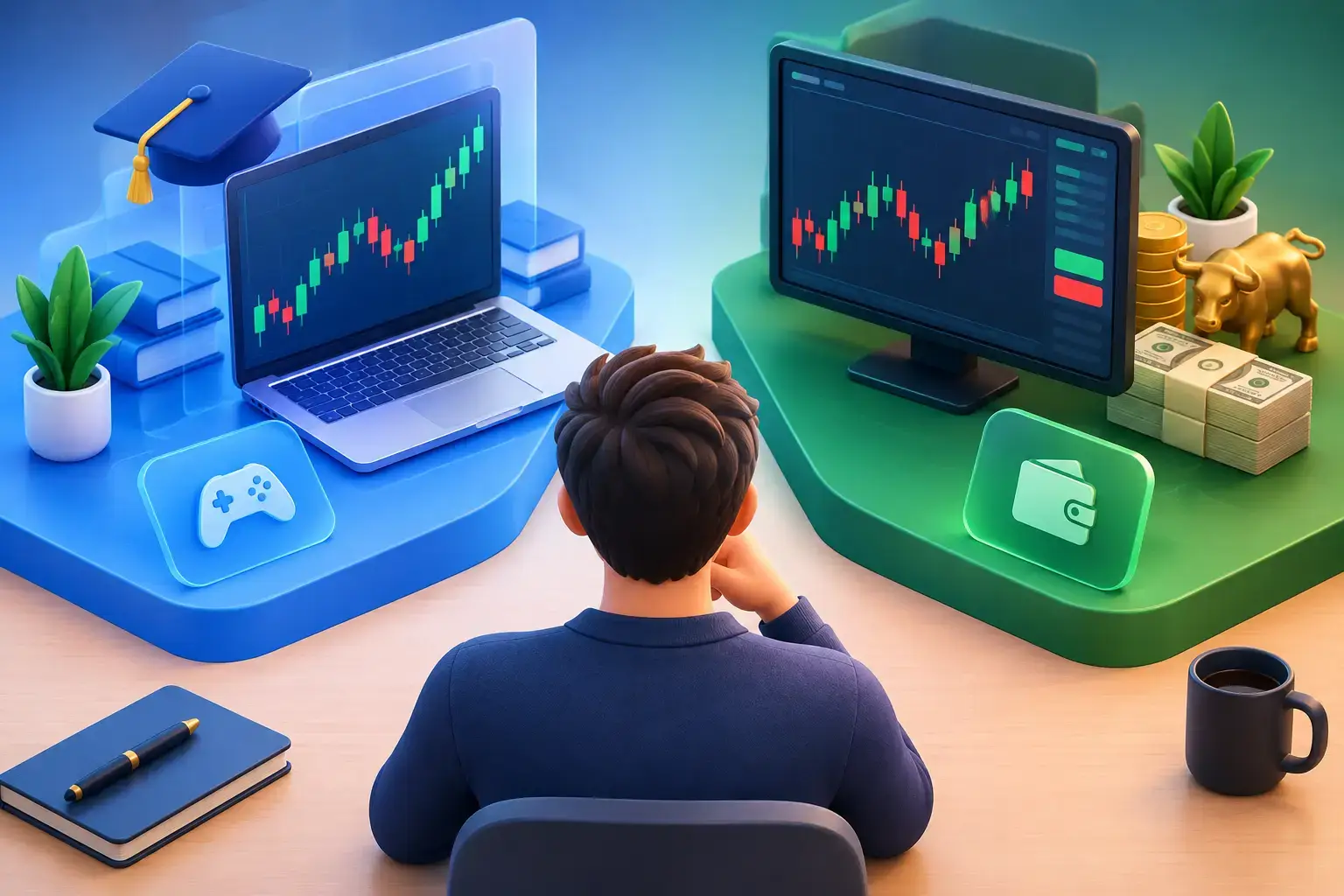
A first successful transaction on a demo platform often creates the impression that you already understand the market. Then, on a real account, the same idea, the same indicator, and sometimes even the same price triggers a completely different emotion. That is precisely why the question - demo account or real trading - is not merely a technical choice. It is a choice between the speed of learning, financial risk, and your own psychological readiness.
A demo account is not "unreal" or a useless exercise. Real trading is also not necessarily the next step just because you had a few profitable weeks. The right path depends on what skill you want to develop right now: using the platform, testing a strategy, managing positions, or making decisions under pressure.
What a demo account teaches you
A demo account gives you market data and a trading platform with virtual capital. You can open positions in stocks, currency pairs, indices, or crypto assets without risking your own money directly. For beginners, this is the safest environment for understanding market mechanics.
At the initial stage, the demo allows mistakes to be cheap. How is a Market, Limit, or Stop order placed? What does leverage mean? Where do you see commission, spread, margin, and the profit or loss of an open position? When you get answers to these questions through actions on screen, theory turns into practical knowledge.
A demo environment is especially useful when you don't yet have a written trading plan. Choose one or two instruments, for example EUR/USD and the S&P 500 index, and observe them daily. Mark support and resistance zones, compare different timeframes, and predefine entry, Stop Loss, and take-profit levels. At this stage, the goal is not to maximize profit. The goal is to be able to explain the logic of each decision.
The demo is also a good place for initial strategy testing. If you think a combination of moving averages and price structure works, don't rely on just two or three successful trades. Gather at least a few dozen examples executed under the same rules. Record the conditions under which you enter, where you exit, and how much you risk. Statistics will tell you far more than a single impressive result.
The main limitation of the demo: psychology is not fully simulated
Virtual losses are often easy to shrug off, because the account balance isn't tied to real goals. In real trading, however, a 2% loss can mean irritation, fear, premature closing, or the urge to quickly recover the lost amount with the next position.
This difference matters. Many traders follow the rules meticulously on demo, but on a real account they cancel the Stop Loss in the hope that the price will "definitely come back." Sometimes they even increase position size simply because the previous trade was a loss. This is not a strategy problem, it is a problem of process discipline.
Execution on a demo can also differ from the ideal. In a fast-moving market, the actual execution price of an order may be worse than planned. Spread, slippage, liquidity, and commissions affect the final result, especially in short-term trading. That's why demo results should be taken as practice, not as a guarantee of future profit.
When is it time for real trading
Switching to a real account doesn't require large capital. On the contrary, the right starting amount is often so small that losing it doesn't change your everyday financial situation. The first real trades have a different purpose: to test whether you can follow the same rules when the outcome is determined by your own money.
Before switching, ask yourself four questions:
- Do you have one clear strategy, rather than ten mismatched ideas?
- Do you know in advance the acceptable loss for each trade?
- Do you keep a record of recent trades showing the reason for entry and the result?
- Can you continue operating with the same volume and rules even after a loss?
If the answer to these questions is unclear, staying on demo is not caution - it's a professional approach. If the answer is positive, a small real account can become your next learning tool.
At the start of real trading, don't change everything at once. Use the same assets, the same timeframe, and the same strategy that you tested on demo. Otherwise, you won't be able to tell whether a change in results was caused by emotion, market conditions, or entirely new rules.
Small capital, big discipline
The most common mistake beginners make is wanting to grow a small account quickly. This is exactly where excessive leverage, oversized positions, and unacceptable risk per transaction appear. A small account doesn't mean you should increase the risk percentage on each position. It means you are protecting your main capital while learning the process under real conditions.
A practical starting rule could be: for each transaction, risk only a small portion of your account, and calculate position size based on the distance to your Stop Loss. For example, if the distance from entry to Stop Loss is large, the position size should be reduced. If the Stop Loss is placed very close just so you can open a large position, you are likely not managing risk at all - you are simply fitting the account's size.
Here, the distinction between investing and active trading also matters. A long-term investor might gradually accumulate a quality asset and not react to daily fluctuations. A short-term trader, however, operates with predefined timing, levels, and risk. Mixing both approaches in one account often creates chaos: a failed short-term position suddenly turns into a "long-term investment."
Demo account or real trading: the better answer is both
A useful approach doesn't treat demo and real accounts as competitors. Use the demo to study a new instrument, a new strategy, or an unfamiliar market. On the real account, work only with the system that has already been tested and that you understand well.
Say you trade stocks and want to move into the crypto market. Instead of testing an unfamiliar asset's sharp movements with real capital, first study its volatility, trading hours, and reaction to news on demo. Or, if you plan to trade Forex pairs following the economic calendar, observe in a demo environment how the spread widens during the release of significant macroeconomic data.
At the same time, staying on demo for months can create a habit of procrastination. If you have a proven strategy, results recorded in a journal, and clear risk rules, trading with a very small real amount will show you something simulation cannot teach: how you react to uncertainty.
A trading journal gives meaning to your choice
It doesn't matter which account you have - if you don't analyze your trades, the same mistake will repeat. In your trading journal, record the asset, entry time, position size, Stop Loss, target, reason for entry, and emotional state. After closing a position, add a screenshot or a brief assessment: did you follow the plan?
Within a few weeks, a more reliable picture will emerge from the journal. You might discover that your best trades happen at a specific time of day. Or that most of your losses come not from the strategy, but from unplanned entries just before news releases. This information is far more valuable than yet another "hot" signal from social media.
Traders' Hub's educational approach is based on exactly this principle: market knowledge becomes strong when theory, real chart analysis, risk management, and regular evaluation of results work together as one system.
Before opening your next position, decide not only what you will buy or sell, but what this trade should teach you. If you know the answer in advance, both the demo and the real account will become tools for your progress - not an emotional bet on the market.